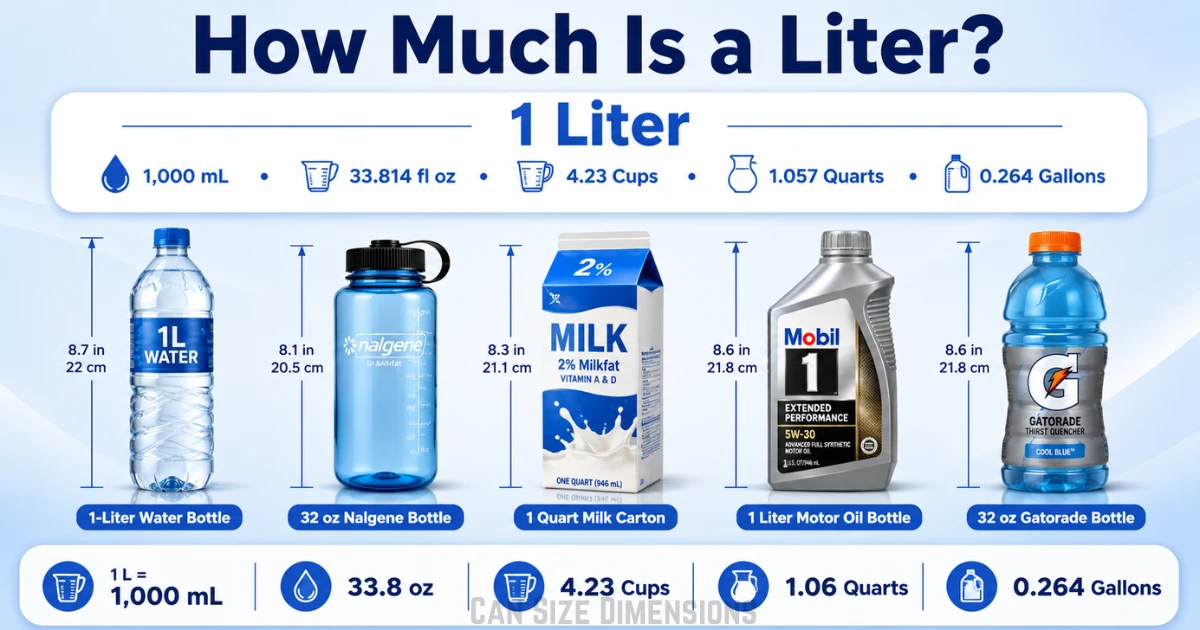
1 liter equals 1,000 milliliters, 33.814 U.S. fluid ounces, 4.23 cups, 1.057 quarts, and 0.264 gallons.
Whether you’re scaling a recipe, tracking your water intake, or filling a gas tank, knowing how much is a liter saves you from costly measurement mistakes.
This guide covers every major conversion with formulas, shortcuts, real-life examples, and the practical context that most guides leave out.
How Much Is a Liter — The Exact Answer
A liter (also spelled litre) is a metric unit of volume equal to exactly 1,000 milliliters (mL). It is the standard unit of liquid measurement used by the International System of Units (SI), maintained by the International Bureau of Weights and Measures (BIPM).
In everyday terms, a liter sits just slightly above a U.S. liquid quart and represents roughly one-quarter of a U.S. gallon. It is the foundational unit in global cooking, clinical medicine, fuel measurement, and hydration science.
Here is the full snapshot:
- 1 liter = 1,000 milliliters (mL)
- 1 liter = 33.814 U.S. fluid ounces
- 1 liter = 4.227 U.S. cups
- 1 liter = 1.057 U.S. liquid quarts
- 1 liter = 0.264 U.S. gallons
- 1 liter = 35.195 Imperial (UK) fluid ounces
How Many Ounces, Cups, Gallons & More in a Liter — Full Conversion Table
How Many Ounces in a Liter (How Many Oz in a Liter)
Formula: Liters × 33.814 = U.S. fluid ounces Shortcut: Round to 34 oz per liter for quick kitchen math
Example: 2 liters × 33.814 = 67.63 fl oz
1 liter = 33.814 U.S. fluid ounces. This is the conversion certified by the National Institute of Standards and Technology (NIST) and used on every product label, recipe, and hydration guideline in the United States.
| Liters | Ounces (fl oz) |
|---|---|
| 1 L | 33.81 oz |
| 2 L | 67.63 oz |
| 3 L | 101.44 oz |
| 4 L | 135.26 oz |
| 5 L | 169.07 oz |
| 6 L | 202.88 oz |
| 7 L | 236.70 oz |
| 8 L | 270.51 oz |
| 9 L | 304.33 oz |
| 10 L | 338.14 oz |
| 11 L | 371.95 oz |
| 12 L | 405.77 oz |
| 13 L | 439.58 oz |
| 14 L | 473.40 oz |
| 15 L | 507.21 oz |
| 16 L | 541.02 oz |
| 17 L | 574.84 oz |
| 18 L | 608.65 oz |
| 19 L | 642.47 oz |
| 20 L | 676.28 oz |
How Many Cups in a Liter
Formula: Liters × 4.22675 = U.S. cups
Shortcut: Just over 4 cups — add 3 tablespoons to hit exactly 1 liter
Example: 1.5 liters × 4.22675 = 6.34 cups
1 liter = 4.227 U.S. cups. The U.S. customary cup is defined as 8 fluid ounces. Since 1 liter equals 33.814 oz, the math lands at 4.23 cups. For baking and cooking, this fraction matters when scaling soup stocks, cake batters, or bread dough recipes.
| Liters | Cups (US) |
|---|---|
| 1 L | 4.23 cups |
| 2 L | 8.45 cups |
| 3 L | 12.68 cups |
| 4 L | 16.91 cups |
| 5 L | 21.13 cups |
| 6 L | 25.36 cups |
| 7 L | 29.59 cups |
| 8 L | 33.81 cups |
| 9 L | 38.04 cups |
| 10 L | 42.27 cups |
| 15 L | 63.40 cups |
| 20 L | 84.54 cups |
| 25 L | 105.67 cups |
| 30 L | 126.80 cups |
| 35 L | 147.94 cups |
| 40 L | 169.07 cups |
| 45 L | 190.20 cups |
| 50 L | 211.34 cups |
How Many Gallons in a Liter
Formula: Liters × 0.264172 = U.S. gallons
Shortcut: Divide liters by 4 for a fast estimate
Example: 5 liters × 0.264172 = 1.32 gallons
1 liter = 0.264 U.S. gallons. It takes nearly 4 full liters to equal one single U.S. gallon. The U.S. gallon is defined as 231 cubic inches, while the liter is a pure metric volume unit rooted in the mass of water at 4°C.
| Liters | Gallons (US) |
|---|---|
| 1 L | 0.264 gal |
| 2 L | 0.528 gal |
| 3 L | 0.793 gal |
| 4 L | 1.057 gal |
| 5 L | 1.321 gal |
| 6 L | 1.585 gal |
| 7 L | 1.849 gal |
| 8 L | 2.113 gal |
| 9 L | 2.378 gal |
| 10 L | 2.642 gal |
| 11 L | 2.906 gal |
| 12 L | 3.170 gal |
| 13 L | 3.434 gal |
| 14 L | 3.698 gal |
| 15 L | 3.963 gal |
| 16 L | 4.227 gal |
| 17 L | 4.491 gal |
| 18 L | 4.755 gal |
| 19 L | 5.019 gal |
| 20 L | 5.283 gal |
| 21 L | 5.547 gal |
| 22 L | 5.812 gal |
| 23 L | 6.076 gal |
| 24 L | 6.340 gal |
| 25 L | 6.604 gal |
| 26 L | 6.868 gal |
| 27 L | 7.132 gal |
| 28 L | 7.397 gal |
| 29 L | 7.661 gal |
| 30 L | 7.925 gal |
| 31 L | 8.189 gal |
| 32 L | 8.453 gal |
| 33 L | 8.717 gal |
| 34 L | 8.982 gal |
| 35 L | 9.246 gal |
| 36 L | 9.510 gal |
| 37 L | 9.774 gal |
| 38 L | 10.038 gal |
| 39 L | 10.302 gal |
| 40 L | 10.567 gal |
| 41 L | 10.831 gal |
| 42 L | 11.095 gal |
| 43 L | 11.359 gal |
| 44 L | 11.623 gal |
| 45 L | 11.887 gal |
| 46 L | 12.151 gal |
| 47 L | 12.416 gal |
| 48 L | 12.680 gal |
| 49 L | 12.944 gal |
| 50 L | 13.208 gal |
How Many Quarts in a Liter
Formula: Liters × 1.05669 = U.S. liquid quarts
Shortcut: 1 liter ≈ 1 quart (just slightly larger)
Example: 3 liters × 1.05669 = 3.17 quarts
1 liter = 1.057 U.S. liquid quarts. The U.S. quart equals exactly 0.946353 liters, so a liter beats a quart by about 57 mL — roughly 4 tablespoons. In cooking terms, swapping a quart for a liter is safely within recipe tolerance.
| Liters | Quarts (US) |
|---|---|
| 1 L | 1.06 qt |
| 2 L | 2.11 qt |
| 3 L | 3.17 qt |
| 4 L | 4.23 qt |
| 5 L | 5.28 qt |
| 6 L | 6.34 qt |
| 7 L | 7.40 qt |
| 8 L | 8.45 qt |
| 9 L | 9.51 qt |
| 10 L | 10.57 qt |
| 11 L | 11.62 qt |
| 12 L | 12.68 qt |
| 13 L | 13.74 qt |
| 14 L | 14.79 qt |
| 15 L | 15.85 qt |
| 16 L | 16.91 qt |
| 17 L | 17.96 qt |
| 18 L | 19.02 qt |
| 19 L | 20.08 qt |
| 20 L | 21.13 qt |
| 21 L | 22.19 qt |
| 22 L | 23.25 qt |
| 23 L | 24.30 qt |
| 24 L | 25.36 qt |
| 25 L | 26.42 qt |
| 26 L | 27.47 qt |
| 27 L | 28.53 qt |
| 28 L | 29.59 qt |
| 29 L | 30.64 qt |
| 30 L | 31.70 qt |
| 31 L | 32.76 qt |
| 32 L | 33.81 qt |
| 33 L | 34.87 qt |
| 34 L | 35.93 qt |
| 35 L | 36.98 qt |
| 36 L | 38.04 qt |
| 37 L | 39.10 qt |
| 38 L | 40.15 qt |
| 39 L | 41.21 qt |
| 40 L | 42.27 qt |
| 41 L | 43.32 qt |
| 42 L | 44.38 qt |
| 43 L | 45.44 qt |
| 44 L | 46.49 qt |
| 45 L | 47.55 qt |
| 46 L | 48.61 qt |
| 47 L | 49.66 qt |
| 48 L | 50.72 qt |
| 49 L | 51.78 qt |
| 50 L | 52.83 qt |
How Many Milliliters Are in a Liter
Formula: Liters × 1,000 = milliliters
Shortcut: Move the decimal point three places to the right
Example: 0.75 liters × 1,000 = 750 mL
1 liter = exactly 1,000 milliliters. This is a fixed, immovable metric system conversion defined by the BIPM. It never rounds, never varies, and applies equally whether you’re measuring water, saline, wine, or motor oil.
| Liters | Milliliters |
|---|---|
| 1 L | 1,000 mL |
| 2 L | 2,000 mL |
| 3 L | 3,000 mL |
| 4 L | 4,000 mL |
| 5 L | 5,000 mL |
| 6 L | 6,000 mL |
| 7 L | 7,000 mL |
| 8 L | 8,000 mL |
| 9 L | 9,000 mL |
| 10 L | 10,000 mL |
| 11 L | 11,000 mL |
| 12 L | 12,000 mL |
| 13 L | 13,000 mL |
| 14 L | 14,000 mL |
| 15 L | 15,000 mL |
| 16 L | 16,000 mL |
| 17 L | 17,000 mL |
| 18 L | 18,000 mL |
| 19 L | 19,000 mL |
| 20 L | 20,000 mL |
Quick Reference — All Conversions at a Glance 🧮
| Unit | Value |
|---|---|
| 1 Liter in mL | 1,000 mL |
| 1 Liter in fl oz (US) | 33.814 fl oz |
| 1 Liter in fl oz (UK) | 35.195 fl oz |
| 1 Liter in cups | 4.227 cups |
| 1 Liter in quarts | 1.057 quarts |
| 1 Liter in gallons | 0.264 gallons |
| 1 Liter in pints | 2.113 pints |
More Posts:How Long Is a Meter? Size Guide, Unit Conversions & Real-Life Examples (2026)
US vs. UK Fluid Ounces — Why the Number Is Different
1 liter = 33.814 U.S. fluid ounces but 1 liter = 35.195 Imperial (UK) fluid ounces.
That is a difference of nearly 1.4 oz per liter — small in a single glass of water, significant across a full recipe.
The gap exists because the U.S. customary system and the British Imperial system define a fluid ounce differently. A U.S. fluid ounce equals 29.5735 mL, while a UK Imperial fluid ounce equals 28.4131 mL. The U.S. ounce is slightly larger, so fewer of them fit in a liter.
5 Real-Life Objects That Show Exactly How Much a Liter Is
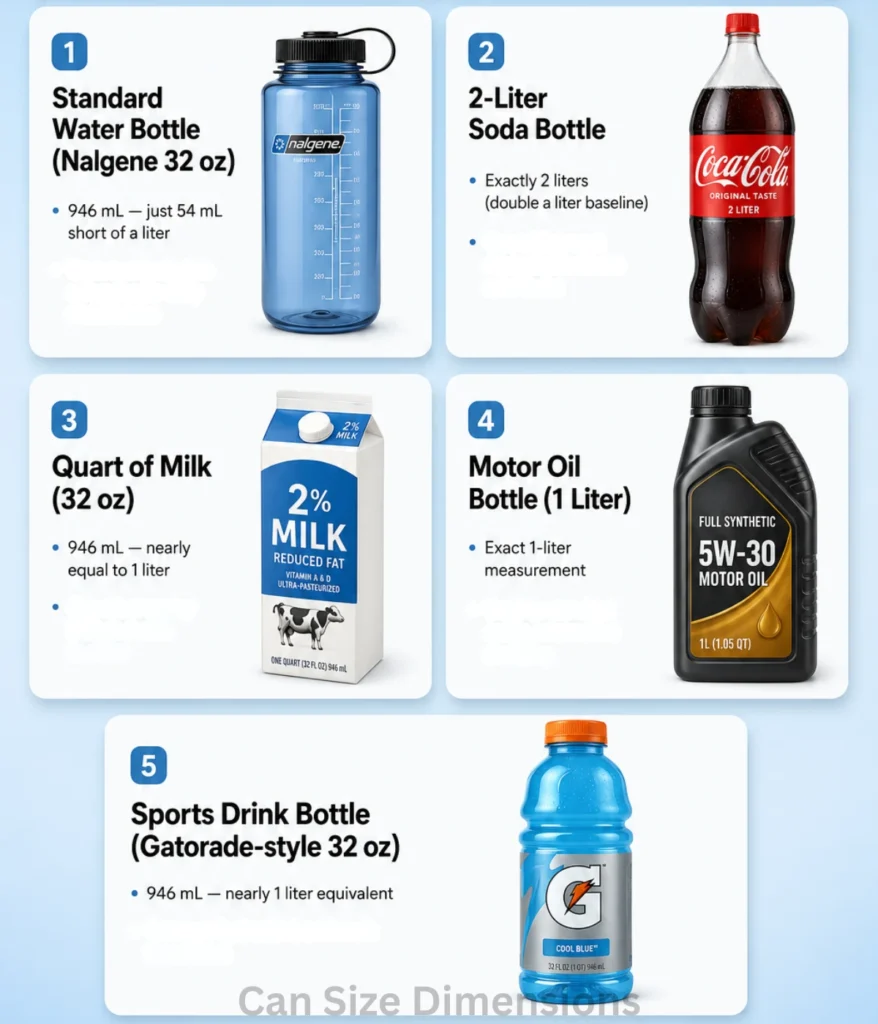
Standard Water Bottle (Nalgene 32 oz)
A Nalgene Wide Mouth 32 oz bottle holds 946 mL — just 54 mL short of a full liter. That gap is roughly 11 teaspoons. In daily hydration planning, that difference matters.
Most adults need between 2 and 3 liters per day according to the National Academies of Sciences, Engineering, and Medicine, so two Nalgene bottles plus a small glass gets you to the daily minimum. Emergency medical departments across the U.S. use 1-liter saline bags as the standard IV rehydration unit — the liter is the clinical baseline for fluid therapy worldwide.
2-Liter Soda Bottle (Coca-Cola)
A Coca-Cola 2L bottle holds exactly 67.6 fl oz and stands roughly 13 inches tall — taller than a standard school ruler.
It is one of the most universally recognized volume references in American households, making it the fastest mental anchor for understanding a liter at double the size. From a nutritional standpoint, that bottle contains approximately 216 grams of sugar — nearly nine times the World Health Organization’s recommended daily sugar limit of 25 grams for adults.
Quart of Milk (Standard 32 oz Carton)
A standard 1-quart (946 mL) milk carton sits within 54 mL of a full liter — the closest everyday kitchen item to the exact liter mark. One liter of whole milk delivers roughly 610 calories, 32 grams of protein, and 1,200 mg of calcium — a nutritional profile tracked in liter-based servings by registered dietitians.
The adult human stomach at comfortable capacity holds approximately 1 liter of volume, which is why drinking a full quart carton of milk at once feels like a lot.
Motor Oil Bottle (Mobil 1 Full Synthetic)
Mobil 1 Full Synthetic motor oil is sold in 1-liter bottles at most auto parts stores, and a standard car engine requires 4 to 5 liters for a complete oil change.
That means a full service uses the volume equivalent of 4–5 standard water bottles. Automotive engineers measure engine displacement, fuel consumption, and fluid capacity entirely in liters — the metric system is the native language of the global transportation industry.
Sports Drink Bottle (Gatorade 32 oz)
A Gatorade Thirst Quencher 32 oz bottle holds 946 mL — close enough to 1 liter that coaches and athletes treat it as a liter-equivalent for hydration planning.
The American College of Sports Medicine recommends replacing approximately 1 liter of electrolyte fluid per hour during sustained activity in hot conditions. One liter of Gatorade contains roughly 270 mg of sodium — about 10% of the average adult’s daily sodium intake, making liter-based math directly relevant to sports nutrition and electrolyte balance.
FAQ — How Much Is a Liter
How much is a liter?
1 liter = 1,000 mL, 33.814 U.S. fl oz, 4.227 cups, 1.057 quarts, and 0.264 U.S. gallons.
How many gallons in a liter?
1 liter = 0.264172 U.S. gallons. Divide liters by 4 for a quick estimate — it takes just under 4 liters to fill 1 gallon.
How many ounces in a liter?
1 liter = 33.814 U.S. fluid ounces. In the UK Imperial system, 1 liter = 35.195 fluid ounces.
How many oz in a liter?
33.8 fl oz. Round to 34 oz per liter for everyday kitchen and hydration use — the error margin is under 0.6%.
How many cups in a liter?
1 liter = 4.227 U.S. cups. Fill 4 full measuring cups and add 3 tablespoons to hit exactly 1 liter.
How many milliliters are in a liter?
Exactly 1,000 mL. This is a fixed metric conversion defined by the BIPM — it never rounds or varies.
How many quarts in a liter?
1 liter = 1.057 U.S. liquid quarts — just slightly more than one quart. Safe to swap in most recipes.
How many ounces are in a liter?
33.814 U.S. fluid ounces. The National Academies of Sciences recommends men drink 3.7 liters (125 oz) and women drink 2.7 liters (91 oz) of total water daily.
Conclusion
How much is a liter has one clean answer: 1,000 mL, 33.814 fl oz, 4.23 cups, 1.057 quarts, or 0.264 gallons — depending entirely on which measurement system you are working in.
From hospital IV bags to Gatorade bottles, gas pumps, and wine racks, the liter is the world’s most practical and widely used unit of liquid volume. Master these conversions once, and every recipe, hydration goal, and fluid measurement you encounter becomes instantly clear.
Bookmark this page — every liter conversion

I’m the admin of CanSizeDimensions.com, sharing clear and accurate Measurement Guides to make everyday decisions easier. I enjoy simplifying complex dimension details so Readers Can Quickly understand sizes, comparisons, and practical uses. My goal is to provide helpful, reliable information for everyone.