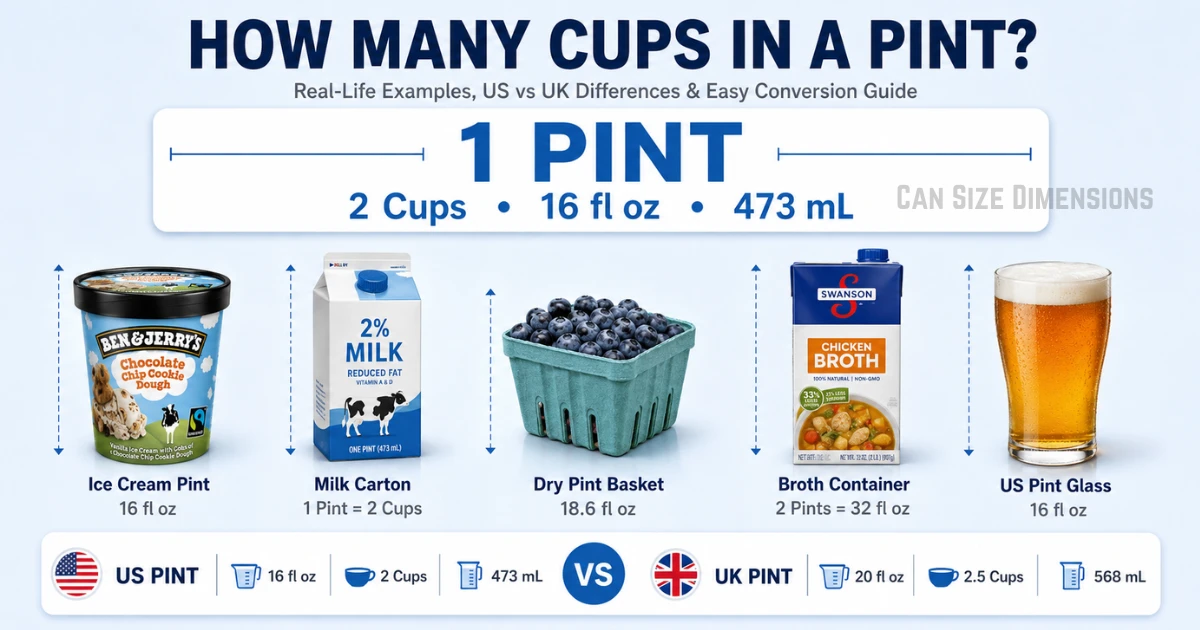
1 pint = 2 cups = 16 fluid ounces = 473 milliliters — that’s the exact answer, whether you’re baking, cooking, or reading a nutrition label.
Knowing how many cups in a pint saves you from measuring mistakes in the kitchen and helps you read recipes, food packaging, and nutrition labels with total confidence.
This guide covers every angle — US vs. UK pints, dry vs. liquid pints, real brand examples, and fast conversion shortcuts you’ll actually use.
How Many Cups Are in a Pint — The Exact Answer
There are exactly 2 cups in 1 US pint.
Each US cup holds 8 fluid ounces. Two cups together hit the full 16 fl oz mark — and that’s your US liquid pint.
This measurement is standardized by the US National Institute of Standards and Technology (NIST) under the US customary units system, the same system used across American kitchens, grocery stores, and food manufacturing facilities nationwide.
Here’s a clean reference chart covering cups to pints across common quantities:
Cups to Pints Conversion Chart
- ½ cup = 0.25 pint = 4 fl oz = 118 mL
- 1 cup = 0.5 pint = 8 fl oz = 237 mL
- 2 cups = 1 pint = 16 fl oz = 473 mL
- 4 cups = 2 pints = 32 fl oz = 946 mL
- 8 cups = 4 pints = 64 fl oz = 1,892 mL
- 16 cups = 8 pints = 128 fl oz = 3,785 mL
This chart directly answers how many cups are in a pint at every scale — from a single serving to a full gallon.
How Many Ounces in a Pint — US vs. UK Difference
There are 16 fluid ounces in a US pint and 20 fluid ounces in a UK Imperial pint — a difference of 4 full ounces per pint.
If you follow a British recipe calling for 1 pint of cream and measure it using a US pint, you’ll be 4 ounces short. That’s enough to change the texture of a sauce, a custard, or a soup entirely.
US Pint vs. UK Pint — Side-by-Side
- US liquid pint = 16 fl oz = 2 cups = 473 mL
- UK Imperial pint = 20 fl oz = 2.5 cups = 568 mL
- Difference = 4 fl oz / 0.5 cup / 95 mL per pint
Always confirm which measurement system your recipe uses before you pour a single cup. This is one of the most commonly missed distinctions in American home cooking.
More Posts:How Many Cups in a Quart? Ounces, Pints & Full Conversion Guide (2026)
How to Convert Cups to Pints — Formula, Shortcut & Quick Chart
The conversion between cups and pints runs on one dead-simple rule.
Formula: Pints = Cups ÷ 2
Reverse Formula: Cups = Pints × 2
Shortcut: Divide by 2 to go from cups to pints. Multiply by 2 to go from pints to cups.
Worked Example: You have 6 cups of chicken broth. How many pints is that? 6 ÷ 2 = 3 pints
Reverse: You need 3 pints of milk for a recipe. How many cups do you measure? 3 × 2 = 6 cups
That’s the entire conversion. No calculator needed once you internalize the ÷2 / ×2 rule.
Quick Reference Chart — Cups to Pints
- ¼ cup = 0.125 pint
- ½ cup = 0.25 pint
- 1 cup = 0.5 pint
- 2 cups = 1 pint
- 3 cups = 1.5 pints
- 4 cups = 2 pints
- 6 cups = 3 pints
- 8 cups = 4 pints
This chart directly answers how many oz in a pint as well — since every US pint = 16 fl oz, and every US cup = 8 fl oz, the math stays consistent across the board.
5 Real-Life Examples of How Much Is a Pint
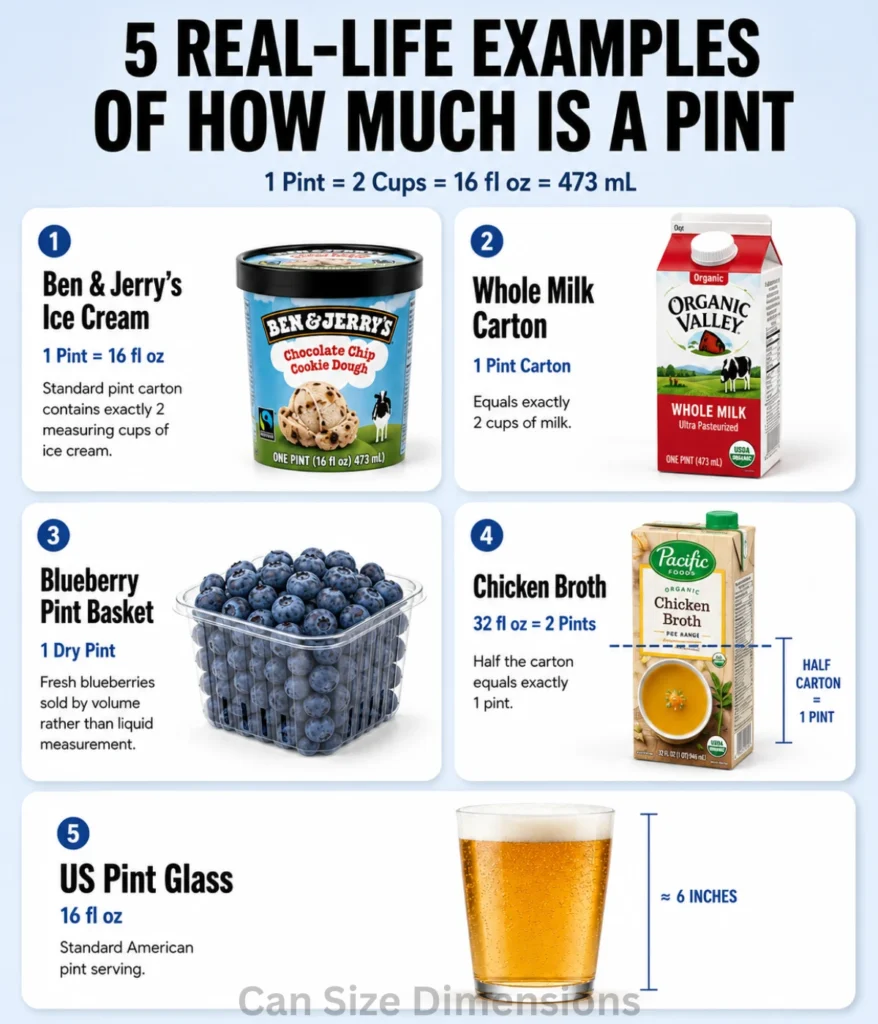
Ben & Jerry’s Ice Cream — 1 Pint = 16 fl oz
Ben & Jerry’s labels its standard cartons as 1 pint (473 mL). That tub holds exactly 2 measuring cups of ice cream — no more, no less. It sits about 3.5 inches in diameter, close to the width of an average adult palm.
A single pint contains roughly 1,000–1,200 calories, a figure registered dietitians reference when discussing caloric density and portion awareness with patients.
Organic Valley Whole Milk — 1 Pint Carton
Organic Valley sells pint-sized (16 fl oz) whole milk cartons that appear in school cafeterias, coffee shops, and home kitchens across the US. One pint of whole milk provides approximately 300–320 mg of calcium — about 25–30% of the daily recommended intake for adults per the USDA Dietary Guidelines.
In the kitchen, this carton equals exactly 2 cups — the precise amount most pancake and béchamel recipes call for.
Driscoll’s Fresh Blueberries — 1 Dry Pint Basket
A Driscoll’s pint basket of blueberries weighs roughly 12 dry ounces, not 16, because fresh produce fills by volume — and air gaps between berries mean the weight doesn’t match a liquid pint.
One pint of blueberries delivers approximately 80 calories and over 3.5 grams of dietary fiber, a reference point physicians cite for cardiovascular health and antioxidant-rich diets.
Swanson Chicken Broth — 32 fl oz = 2 Pints
Swanson’s standard 32 fl oz carton equals exactly 2 pints. Half that carton — 1 pint = 16 fl oz = 2 cups — is the amount called for in most American risotto, gravy, and soup recipes.
In medical nutrition, low-sodium broth in pint-sized servings is frequently prescribed by registered dietitians for post-surgery liquid diets, delivering roughly 30–40 calories per 16 oz serving.
Sierra Nevada Pale Ale — US Pint Glass = 16 fl oz
A certified US pint glass holds exactly 16 fl oz of beer. A British Imperial pint glass holds 20 fl oz — a 4-ounce difference that affects both cost and caloric intake per serving. A standard 16 oz US pint of beer contains roughly 150–200 calories and around 14–15 grams of alcohol. A pint glass stands about 6 inches tall — roughly the length of an adult hand from wrist to fingertip.
Dry Pint vs. Liquid Pint — The Difference Most People Get Wrong
This is the angle most competitor blogs skip entirely — and it causes real measurement errors in American kitchens.
A US liquid pint = 16 fl oz (473 mL). A US dry pint = 18.6 fl oz (551 mL).
That’s a difference of 2.6 fluid ounces per pint — significant enough to throw off a baked recipe if you confuse the two.
When does the dry pint apply?
The US dry pint applies to produce sold by volume at grocery stores and farmers markets — think strawberries, blueberries, cherry tomatoes, and snap peas. These items are measured in dry pint baskets, not liquid measuring cups.
The critical rule: Never use a liquid measuring cup to measure dry produce sold in pint baskets. The volumes don’t match.
- 1 liquid pint = 2 cups of water, milk, or broth
- 1 dry pint = roughly 2.3 cups of volume — but it’s never used for liquids
The US dry pint is defined under the US customary units system and is distinct from the Imperial dry pint used in the UK and Canada. For everyday American cooking, the rule is simple: if it pours, use a liquid pint (16 fl oz). If it’s produce in a basket, it’s a dry pint (18.6 fl oz).
FAQ — How Many Cups in a Pint & Common Pint Questions
How many cups in a pint?
There are exactly 2 cups in 1 US pint.
How many ounces in a pint?
A US pint holds 16 fluid ounces. A UK Imperial pint holds 20 fluid ounces.
How many oz in a pint?
16 oz in a US pint. Always confirm US vs. UK before measuring.
How many cups are in a pint?
Exactly 2 cups, since each cup = 8 fl oz and 2 × 8 = 16 fl oz = 1 pint.
How much is a pint?
1 pint = 16 fl oz = 2 cups = 473 mL in the US customary system.
How many ounces are in a pint?
16 fluid ounces in a US pint. 20 fluid ounces in a UK Imperial pint.
How big is a pint?
A standard US pint container stands roughly 4–6 inches tall depending on the product — about the length of an adult hand. It holds 2 cups or 16 fl oz of liquid.
Conclusion
How many cups in a pint has one clear answer: 2 cups, 16 fl oz, 473 mL — every single time in the US system.
Remember the ÷2 rule for cups to pints, watch for the US vs. UK 4-ounce gap, and never confuse a liquid pint with a dry pint when measuring produce. With these three facts locked in, every recipe, nutrition label, and grocery measurement becomes effortless.

I’m the admin of CanSizeDimensions.com, sharing clear and accurate Measurement Guides to make everyday decisions easier. I enjoy simplifying complex dimension details so Readers Can Quickly understand sizes, comparisons, and practical uses. My goal is to provide helpful, reliable information for everyone.