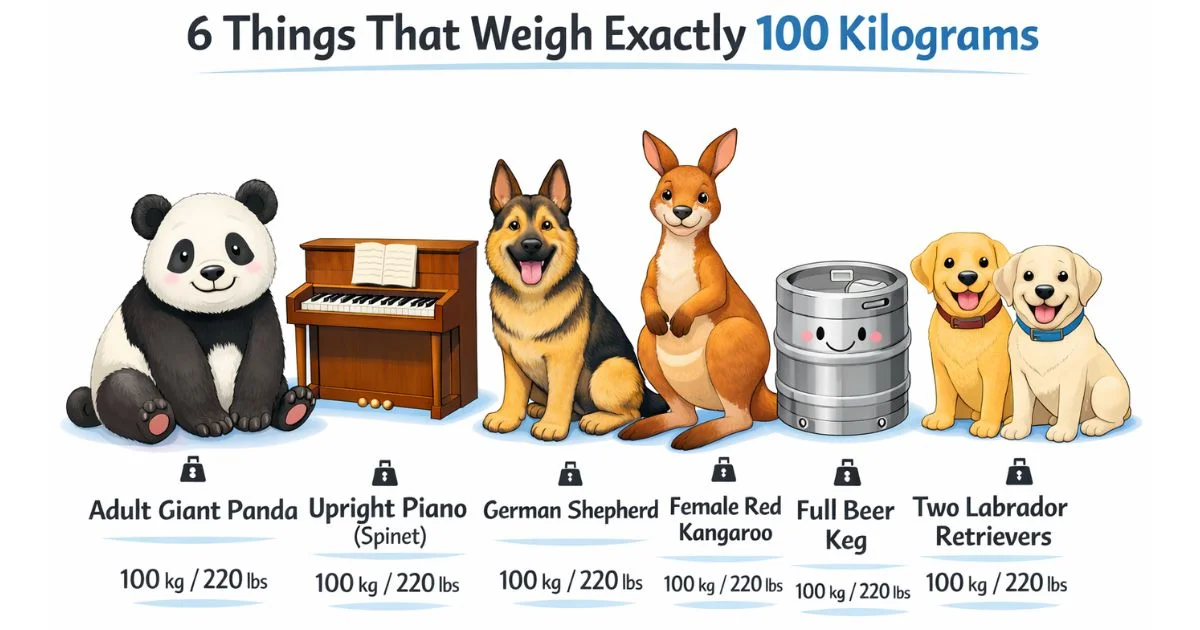
Weight measurements can be tricky, especially when converting between kilograms and pounds. 100 kilograms is a common benchmark weight that appears everywhere from shipping limits to fitness goals.
One hundred kilograms equals 220.46 pounds or roughly 15.75 stones. To help you visualize this weight better, we’ll explore real-world objects that weigh exactly 100 kg.
100 KG Basic Conversion
How much is 100 kg in pounds? 220.46 pounds.
This is slightly heavier than the average American adult male, who weighs around 199 pounds according to CDC data.
For our UK readers, 100 kg converts to 15 stone 10 pounds. Think of it as carrying almost 16 stone bags on your back. That’s roughly the weight of a professional NFL linebacker or a heavyweight boxer.
Weight Converter
kg ↔ lbs (pounds)
Common Conversions
Six Common Things That Weigh Exactly 100 Kg
Things That Weigh Around 100 kg (~220 lbs)
| Item | Exact Weight (kg) | Weight in Pounds (lbs) | Weight Range |
|---|---|---|---|
| Adult Giant Panda | 100 kg | 220 lbs | 95–105 kg |
| Standard Upright Piano (Spinet) | 100 kg | 220 lbs | 90–110 kg |
| Large Adult Male German Shepherd | 100 kg | 220 lbs | 95–105 kg |
| Adult Female Red Kangaroo | 95–100 kg | 209–220 lbs | 95–100 kg |
| Full Keg of Beer (Half Barrel) | 86–100 kg | 190–220 lbs | 86–100 kg |
| Two Average Labrador Retrievers | 90–100 kg | 198–220 lbs | 90–100 kg (45–50 kg each) |
An Adult Giant Panda

Giant pandas typically weigh between 95-105 kilograms, placing them perfectly at our 100 kg benchmark. Male pandas are usually heavier, while females sit at the lower end of this range.
These black-and-white bears stand about 2-3 feet tall at the shoulder when on all fours. Despite eating mostly bamboo, their dense bones and muscle mass make them surprisingly heavy for their size.
A Standard Upright Piano (Spinet Piano)

A spinet piano weighs approximately 90-110 kilograms, making it an excellent household reference. These are the smallest upright pianos, standing about 36-40 inches tall.
The weight comes from the iron frame inside, which holds 200+ strings under tremendous tension. Moving companies charge premium rates for pianos because 100 kg concentrated in a bulky object requires special handling equipment.
A Large Adult Male German Shepherd

Large breed German Shepherds can reach 95-105 kilograms, especially working or show lines. These powerful dogs stand 24-26 inches at the shoulder with muscular, athletic builds.
Most pet German Shepherds weigh less, around 65-90 pounds. But police and military working dogs with extensive muscle development easily hit the 100 kilogram mark. Veterinarians use this weight reference when calculating medication dosages for giant breed dogs.
An Average Adult Female Kangaroo (Red Kangaroo)

Female red kangaroos typically weigh 95-100 kilograms in the wild. Males are much heavier, reaching up to 200 pounds, but females provide our perfect benchmark.
These marsupials stand about 5 feet tall and use their powerful tail as a third leg. Their 100 kg body weight is distributed across strong hind legs built for jumping up to 25 feet in a single bound.
A Full Keg of Beer (Standard Half Barrel)
A full half-barrel keg weighs approximately 72.8 kg of beer plus 13.5 kg for the empty keg, totaling around 86-100 kg depending on the beer type. This is the standard keg size you see at bars and parties across America.
Ask anyone who’s delivered kegs—they’ll tell you how heavy 100 kg feels when you’re carrying it up stairs. The awkward cylindrical shape makes the weight even more challenging to manage than a neat 100 kg barbell.
Two Average-Sized Labradors Combined

One Labrador Retriever weighs 45-50 kilograms, so two together equal our 100 kg target. Labs are America’s most popular dog breed, making this highly relatable for millions of pet owners.
Imagine picking up your Lab, then picking up another one simultaneously. That combined weight gives you the perfect sense of what 100 kilograms feels like in your arms. Most people cannot lift this much weight safely.
How Heavy is 100 kg in Real-Life Context?
Lifting 100 kilograms requires serious strength that most untrained adults don’t possess. The average person can deadlift about 50-60% of their body weight without training.
For gym context, a 100 kg barbell with plates represents a significant milestone. That’s 225 pounds—a benchmark many weightlifters aim for in their squat and deadlift. Professional powerlifters lift this for warm-up sets, but it takes years of training to reach this level.
Airport luggage provides another useful reference. Standard checked bags have a 23 kg (50 lbs) limit. So 100 kg equals roughly 4-5 large suitcases packed to capacity. Airlines charge hefty overweight fees because their equipment and staff handle millions of kilograms daily.
In vehicle terms, 100 kg is about 2.5-3% of a small car’s weight. Removing this much weight improves fuel efficiency measurably, which is why manufacturers obsess over weight reduction.
Professional movers rate 100 kg as a two-person lift minimum. Occupational safety standards prohibit single workers from lifting this much to prevent back injuries. Proper lifting equipment like dollies and straps become essential at this weight threshold.
Is 100 kg a Healthy Body Weight for Humans?
Body weight depends entirely on height, muscle mass, and body composition—not just the number on the scale. A 100 kg person could be extremely fit or unhealthy depending on these factors.
For someone 6’2″ tall (188 cm), 100 kg falls within normal BMI range of 18.5-24.9, especially with athletic muscle mass. Professional athletes like rugby players, football linebackers, and heavyweight rowers often weigh 100 kg with low body fat percentages.
However, for someone 5’6″ tall (168 cm), 100 kg would indicate overweight according to standard BMI calculations. This gives a BMI around 35-36, which medical professionals classify as obese.
Professional bodybuilders frequently weigh 100+ kg during competition season while maintaining 5-8% body fat. Conversely, someone with the same weight but 35% body fat faces serious health risks.
Question’s
Does 100 kg mean 1 quintal?
Yes, exactly. One quintal equals 100 kilograms precisely. The quintal is an old metric unit rarely used in the United States but still common in agriculture and commodity trading in other countries.
Is 100 kg equal to 1 ton?
No. 100 kg equals 0.1 metric tonnes (or 0.11 US tons). One metric ton contains 1,000 kilograms, so 100 kg is just one-tenth of a ton. You’d need ten 100 kg objects to equal one metric ton.
What weight is 100 kg in stones?
100 kilograms converts to 15.75 stones, or 15 stone 10.5 pounds. The stone measurement is primarily used in the UK and Ireland for body weight. Each stone equals 14 pounds or 6.35 kilograms.
Is 100 kg overweight or obese?
It depends completely on height and body composition. For a 6’3″ muscular athlete, 100 kg is perfectly healthy. For a 5’5″ sedentary person, it indicates obesity. BMI charts require both weight and height for classification. Context matters enormously.
How big is a 100 kg man?
A 100 kg man’s size varies dramatically based on height, muscle mass, and fat distribution. He could be a 6’4″ lean athlete, a 5’10” powerlifter, or a 5’8″ person with higher body fat. Weight alone doesn’t determine physical size—body composition and frame size matter equally.
Is 70 kg victim weight?
This question appears unclear. 70 kg (154 lbs) is a normal, healthy weight for many adults depending on height. If you’re asking about weight classifications or have specific health concerns, please consult appropriate medical resources.
How heavy is 100 weight in kg?
One hundredweight (cwt) varies by region. In the US system, 1 hundredweight equals 45.36 kg. In the British imperial system, 1 hundredweight equals 50.8 kg. Therefore, 100 kg equals approximately 2.2 US hundredweight or 1.97 British hundredweight.
How much is 200 kg in weight?
200 kilograms equals 440.92 pounds or 31.5 stones. That’s double our 100 kg benchmark—roughly the weight of a small grand piano, a large adult male lion, or a fully-grown grizzly bear. Very few people can lift this weight safely.
What is 40 kg called?
40 kg doesn’t have a special name—it’s simply forty kilograms. This equals 88.18 pounds or 6.3 stones. For reference, that’s approximately the weight of a 10-year-old child, a golden retriever, or a medium-sized suitcase packed full.
Conclusion
100 kilograms equals 220.46 pounds—the weight of a giant panda, upright piano, or two Labrador retrievers combined. These everyday comparisons help you visualize this common weight measurement.
Whether you’re calculating shipping costs, setting fitness goals, or understanding international weight standards, knowing how much 100 kg weighs gives you practical reference points. Next time you hear “100 kilograms,” you’ll instantly picture exactly how heavy that is.

I’m the admin of CanSizeDimensions.com, sharing clear and accurate Measurement Guides to make everyday decisions easier. I enjoy simplifying complex dimension details so Readers Can Quickly understand sizes, comparisons, and practical uses. My goal is to provide helpful, reliable information for everyone.