Getting your beer can label dimensions right is crucial for a professional-looking product. The wrong size means wasted materials, poor shelf appeal, and frustrated applicators.
This guide breaks down everything you need to know about standard can label sizes, international dimensions, and how to measure for custom cans.
Standard Beer Can Label Dimensions for 12 oz and 16 oz Cans
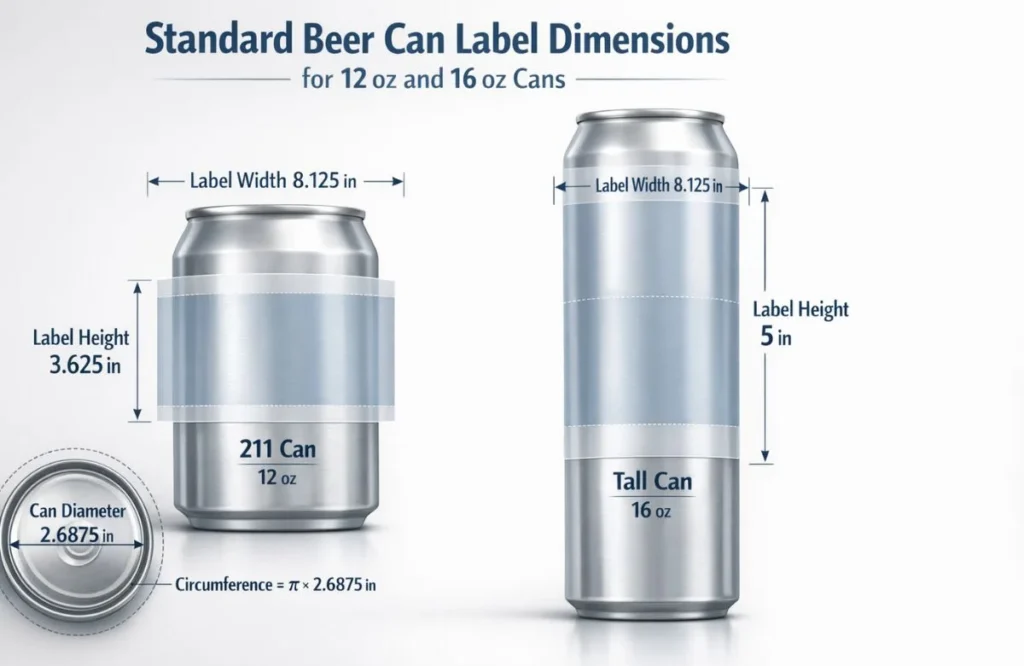
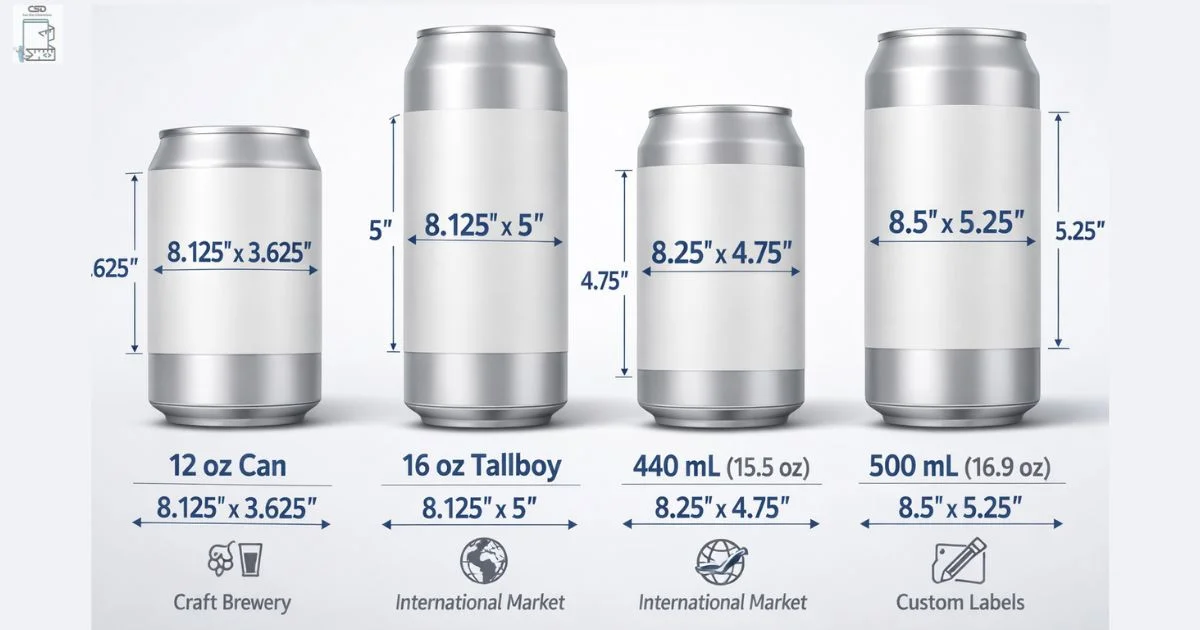
The standard 12 oz beer can label measures 8.125 inches wide by 3.625 inches tall. This fits what the industry calls a “211” can, which has a diameter of 2 11/16 inches (or 2.6875 inches).
Here’s how the math works: multiply the diameter by pi (3.1416) and you get 8.443 inches of circumference. Labels are cut to 8.125 inches to leave room for overlap and ensure clean application.
For 16 oz cans, the width stays at 8.125 inches but the height jumps to 5 inches. The taller can needs more vertical coverage while maintaining the same diameter as the 12 oz version.
International Beer Can Label Sizes: 440mL and 500mL Dimensions

European 440mL cans typically use labels around 8.25 inches wide by 4.75 inches tall. The slight width increase accommodates minor diameter variations in European aluminum cans.
500mL beer cans are slightly larger and need labels measuring approximately 8.5 inches by 5.25 inches. If you’re exporting to European markets, these measurements ensure proper coverage without gaps.
For 500mL bottles (not cans), label dimensions vary widely based on bottle shape. A standard 500mL longneck bottle typically uses a 3.5 inch by 4 inch front label and a 2 inch by 3 inch back label.
Bomber-style 500mL bottles need larger formats around 4 inches by 5 inches.
How to Calculate Beer Can Label Dimensions for Any Can Size
Paper Template Method
The most accurate way: wrap a strip of paper around the can, mark the overlap, and measure. This gives your exact label width for perfect fit.
Measuring Height
Stand the can on a flat surface and measure from bottom rim to desired top edge. Leave at least 1/4 inch clearance top and bottom for applicator grips.
Post-COVID Can Variations
Many breweries now receive 207-16 cans (narrower diameter: 2 7/16″) instead of standard 211-16, significantly changing label requirements.
Adjust for 207 Cans
If gaps or margins look off, measure diameter. 207 cans require label width of about 7.65 inches instead of the standard 8.125 inches.
Full Wrap vs. Partial Wrap
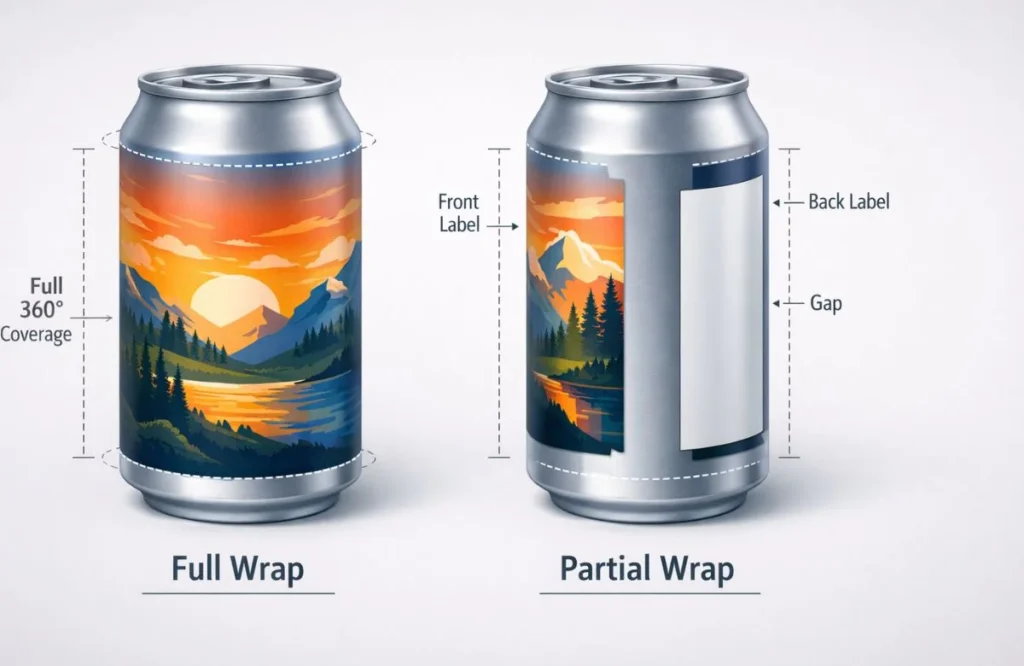
Full wrap labels circle the entire can with one continuous design. The label width matches the can’s circumference (minus overlap), creating a seamless 360-degree canvas.
Partial wrap labels use separate front and back labels on the same roll. The front label typically measures 3 to 4 inches wide while the back label runs 2.5 to 3.5 inches wide.
Most craft breweries choose full wraps for their core lineup and partial wraps for limited releases. Full wraps cost slightly more but eliminate the risk of misaligned front-and-back placement.
Check with your canning line operator before finalizing dimensions. Some applicators handle only one format, and discovering incompatibility after printing is an expensive mistake.
Custom Beer Can Label Shapes and Non-Standard Dimensions in 2026
Die-Cut Custom Shapes
Break from rectangles with rounded tops, curved sides, or geometric cutouts. Width must still match can circumference for proper fit.
Crowler Labels (32 oz)
Standard size: 10 inches wide × 7 inches tall. Larger canvas allows bold graphics and detailed brewing info.
Growler Labels (64 oz)
Common dimensions: 12 inches × 8 inches or custom shapes designed to wrap jug-style containers.
Shrink Sleeves
Printed flat (e.g., 8.9″ wide × 5″ tall for 12 oz), then heat-shrunk to conform perfectly to the can.
Design Constraints
Avoid sharp corners < 1/8" radius and internal cutouts < 1/4" to prevent die-cutting and application issues.
Work With Your Printer
Collaborate early — using stocked dies saves $200–500 in tooling. Unique shapes add about 1 extra week to production.
Other Dimensions: Aluminum Can Size Dimensions in 2026
Question’s
What are the dimensions of a beer can label?
Standard beer can labels measure 8.125 inches wide by 3.625 inches tall for 12 oz cans and 8.125 inches wide by 5 inches tall for 16 oz cans.
What are the dimensions of a standard beer can?
A standard 12 oz beer can (211 size) has a diameter of 2.6875 inches and stands approximately 4.75 inches tall. A 16 oz can uses the same diameter but increases to about 6.25 inches in height.
What is a standard label size?
The most common standard is 8.125″ x 3.625″ for 12 oz cans, which accounts for roughly 90% of craft beer labels in the United States.
How big is a 500mL beer can?
A 500mL can typically measures about 2.6 inches in diameter and 6.75 inches tall, requiring labels around 8.5 inches wide by 5.25 inches tall.
What size label for 500ml bottle?
500mL bottles vary by shape, but standard sizing is 3.5″ x 4″ for front labels and 2″ x 3″ for back labels on longneck bottles.
What are the dimensions of a 440mL can?
440mL cans are common in Europe and UK markets, measuring approximately 2.6 inches diameter with labels sized at 8.25″ x 4.75″ for proper coverage.
What are standard beer sizes?
Standard sizes in the US include 12 oz (355mL), 16 oz (473mL), 19.2 oz, 24 oz, 32 oz (crowlers), and 64 oz (growlers). Internationally, 330mL, 440mL, and 500mL are common.
How to find the label size?
Wrap paper around your can, mark the overlap point, then measure the paper width. Measure height directly on the can from bottom to desired end point, leaving 1/4 inch margins.
How big is a 3×3 label?
A 3×3 label measures 3 inches by 3 inches square, totaling 9 square inches. This size is too small for standard beer cans but works for sample bottles or small jar applications.
Wrapping Up Your Label Dimensions
Beer can label dimensions don’t need to be complicated. Stick with 8.125″ x 3.625″ for 12 oz cans and 8.125″ x 5″ for 16 oz cans, and you’ll match industry standards.

I’m the admin of CanSizeDimensions.com, sharing clear and accurate Measurement Guides to make everyday decisions easier. I enjoy simplifying complex dimension details so Readers Can Quickly understand sizes, comparisons, and practical uses. My goal is to provide helpful, reliable information for everyone.