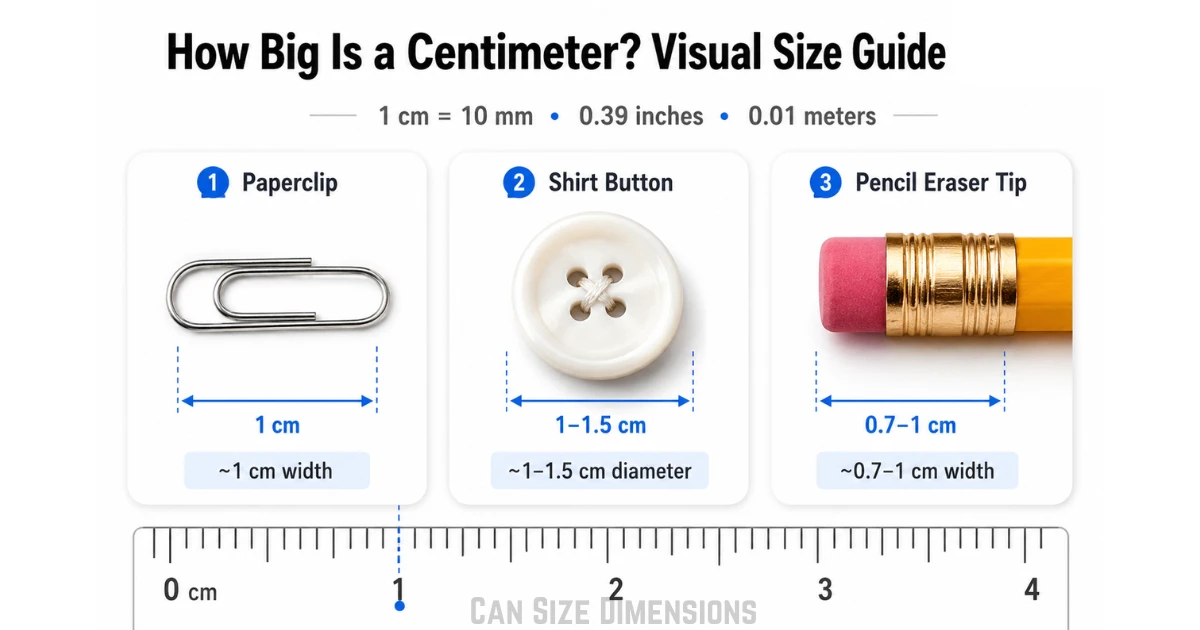
1 centimeter = 10 millimeters = 0.39 inches = 0.01 meters — roughly the width of your pinky fingernail.
Most people in the USA struggle to picture how big a centimeter is without a ruler nearby. That ends here. This guide gives you fast, clear answers backed by real-life examples you already know.
How Long Is a Centimeter Exactly?
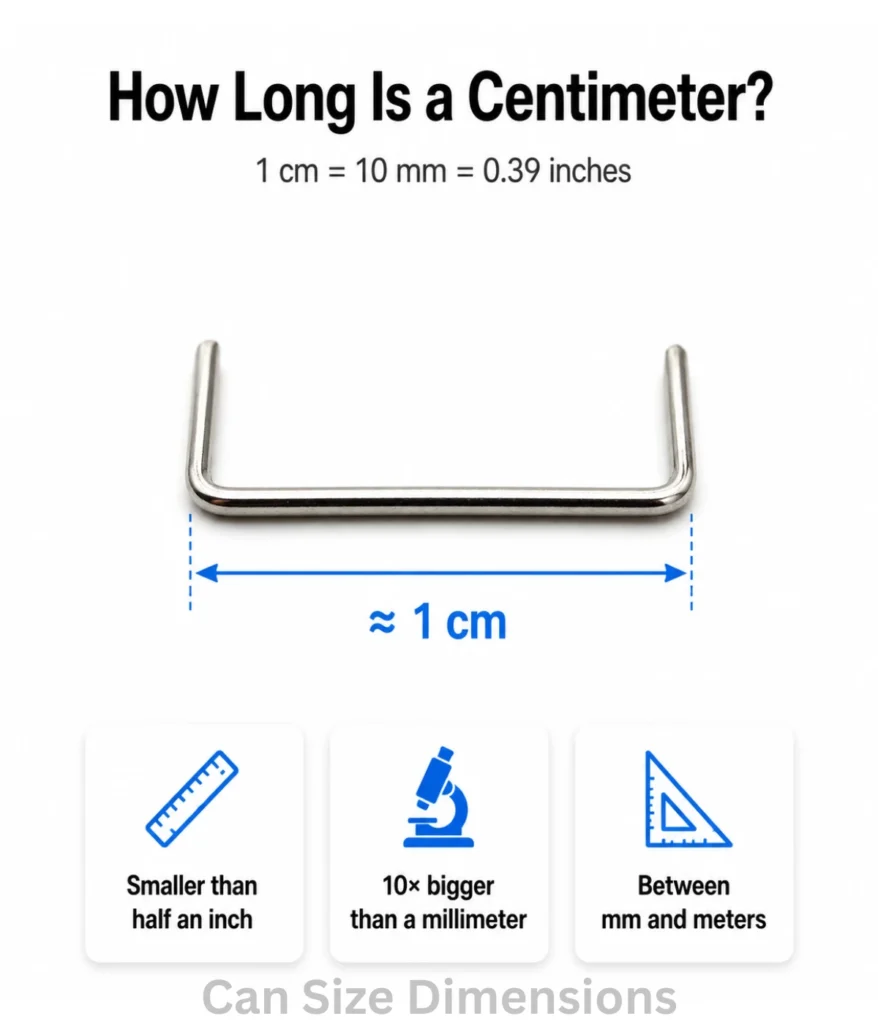
A centimeter (cm) is a unit of length in the metric system. It equals one-hundredth of a meter.
The word comes from the Latin centum (hundred) and the French mètre. It was first standardized in 1801 as part of the International System of Units (SI).
How long is a centimeter visually?
- It is smaller than half an inch
- It is 10 times larger than a millimeter
- It sits right between millimeters and meters on the metric scale
A quick way to picture it: the width of a standard office staple is almost exactly 1 cm. Most Americans have one on their desk right now.
How Big Is a Centimeter Compared to Every Unit?
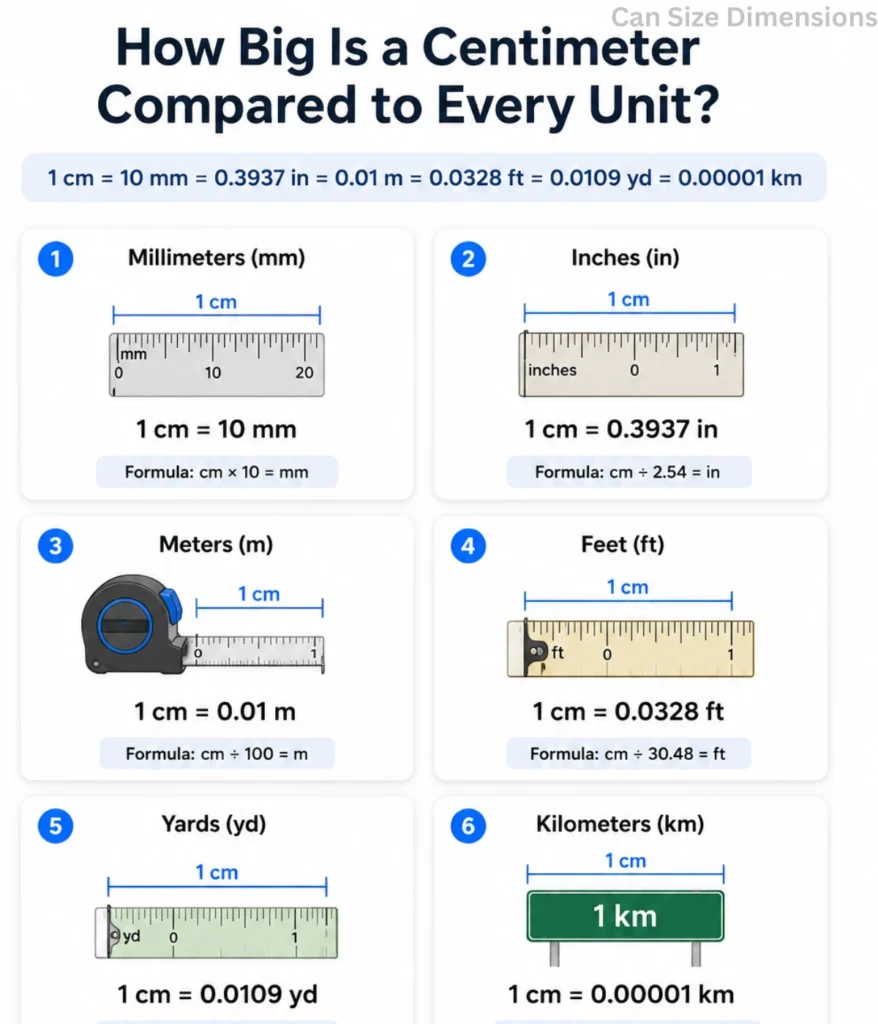
The master conversion fact
1 cm = 10 mm = 0.3937 in = 0.01 m = 0.0328 ft = 0.0109 yd = 0.00001 km
Centimeters to Millimeters
Formula: cm × 10 = mm
Shortcut: Just add a zero. 5 cm → 50 mm. 12 cm → 120 mm.
How many millimeters in a centimeter? Exactly 10 mm. Think of 10 grains of rice lined up side by side — that is one full centimeter.
Example: 7 cm × 10 = 70 mm
| Centimeters | Millimeters |
|---|
Centimeters to Inches
Formula: cm ÷ 2.54 = inches
Shortcut: Multiply by 0.4 for a fast rough estimate. For precision, always divide by 2.54.
How many inches in a centimeter? 1 cm = 0.3937 inches. Flip it around: 1 inch = 2.54 cm exactly. This is the one conversion worth memorizing if you switch between metric and imperial systems daily.
Example: 10 cm ÷ 2.54 = 3.94 inches
| Centimeters | Inches |
|---|
Centimeters to Meters
Formula: cm ÷ 100 = meters
Shortcut: Move the decimal point two places to the left. 250 cm → 2.50 m. That is all there is to it.
Example: 180 cm ÷ 100 = 1.80 meters (average adult height)
| Centimeters | Meters |
|---|
Centimeters to Feet
Formula: cm ÷ 30.48 = feet
Shortcut: Divide by 30 for a quick rough estimate. Divide by 30.48 for the exact answer.
Example: 150 cm ÷ 30.48 = 4.92 feet
| Centimeters | Feet |
|---|
Centimeters to Yards
Formula: cm ÷ 91.44 = yards
Shortcut: Divide by 90 for a fast estimate. Divide by 91.44 for precision.
Example: 300 cm ÷ 91.44 = 3.28 yards
| Centimeters | Yards |
|---|
Centimeters to Kilometers
Formula: cm ÷ 100,000 = kilometers
Shortcut: Move the decimal point five places to the left. 500,000 cm → 5.00 km. Instant.
Example: 250,000 cm ÷ 100,000 = 2.5 km
| Centimeters | Kilometers |
|---|
Centimeters to Miles
Formula: cm ÷ 160,934 = miles
Shortcut: This conversion is rare in daily use. Just remember 1 mile = 160,934 cm and divide accordingly.
Example: 160,934 cm ÷ 160,934 = 1 mile
| Centimeters | Miles |
|---|
All Shortcuts at a Glance
| Conversion | Rule |
|---|---|
| cm → mm | Multiply by 10 |
| cm → inches | Divide by 2.54 |
| cm → feet | Divide by 30.48 |
| cm → meters | Divide by 100 |
| cm → yards | Divide by 91.44 |
| cm → km | Divide by 100,000 |
| inches → cm | Multiply by 2.54 |
| mm → cm | Divide by 10 |
| feet → cm | Multiply by 30.48 |
| meters → cm | Multiply by 100 |
5 Real-Life Examples That Show Exactly How Big a Centimeter Is
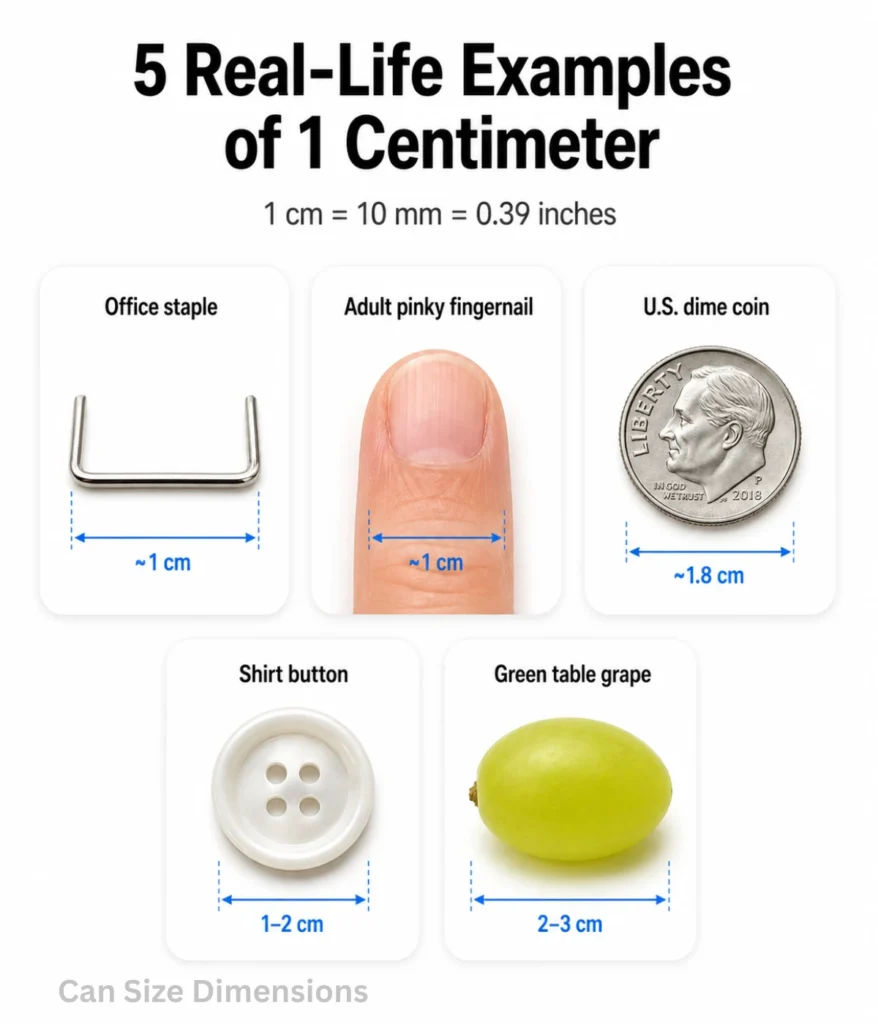
A Standard Office Staple Is ~1 Centimeter Wide
A regular staple — the kind loaded into a Swingline or Bostitch stapler — measures almost exactly 1 cm across when closed. It is dimensionally consistent, meaning every single staple is the same size. This makes it the most precise everyday 1 cm reference you can find.
Your Pinky Fingernail Is ~1 Centimeter Wide
The average adult pinky fingernail measures approximately 1 cm in width. This is widely taught in nursing education as a quick bedside estimation tool. It turns your own body into a zero-cost measuring device — no ruler needed, ever.
A U.S. Dime Is ~1.8 Centimeters in Diameter
The United States dime has an official diameter of 17.91 mm — just under 1.8 cm. Because the U.S. Mint controls its dimensions under federal standards, it is one of the most dimensionally reliable everyday objects in America.
Pull a dime from your pocket. That is just under 2 cm in your hand.
A Shirt Button Is 1–2 Centimeters in Diameter
A standard dress shirt button ranges from 1 cm to 2 cm in diameter. Collar buttons sit closer to 1 cm. Mid-shirt buttons are around 1.5 cm. Tailors and seamstresses use centimeter measurements as their default standard — which is why clothing labels in most countries show measurements in cm.
A Table Grape Is About 2–3 Centimeters Wide
A standard table grape (Thompson Seedless, Red Globe) measures roughly 2–3 cm in diameter. This is the same measurement range that oncologists and physicians use when describing masses or lymph nodes to patients. When a doctor says “about the size of a grape,” they mean roughly 2 to 3 centimeters.
How to Visualize a Centimeter Without a Ruler
The Body Ruler Method
Your own body carries built-in measurement references that you carry everywhere. Pinky fingernail width is ~1 cm, thumb width at the knuckle is ~2.5 cm (roughly 1 inch), and four fingers held together span ~7–8 cm.
This technique is actively taught in nursing schools and first-aid training programs. It lets clinicians quickly estimate wound size, skin lesion diameter, and bruise dimensions without any measuring tool.
The Coin Method
The U.S. dime is 1.79 cm (just under 2 cm). The U.S. penny is 1.905 cm (just under 2 cm). The U.S. quarter is 2.426 cm (just over 2 cm).
All three coins are federally standardized by the U.S. Mint, making them among the most reliable portable centimeter references available.
The Pocket Object Method
A standard staple is ~1 cm, an AAA battery diameter is ~1.05 cm, a pencil diameter is ~0.7 cm, a shirt collar button is ~1 cm, and a ballpoint pen cap width is ~1.1 cm.
The Key Insight
You do not need a ruler to understand how big a centimeter is. Once you lock in two or three personal reference points — your pinky nail, a dime, a staple — centimeter visualization becomes instant and automatic.
FAQ’s About How Big Is a Centimeter?
How big does 1 cm look like?
One centimeter looks like the width of a standard office staple or the width of an adult pinky fingernail. It is smaller than half an inch and about the size of a large pencil eraser tip.
How big is a 1 cm tumor?
A 1 cm tumor is roughly the width of a pinky fingernail — about 10 millimeters in diameter. In oncology, it is considered small. For context, Stage I breast cancer is defined as 2 cm or smaller by the American Cancer Society.
Is 1 cm half an inch?
No. One centimeter is not half an inch. It equals approximately 0.39 inches — slightly less than four-tenths of an inch. Half an inch equals 1.27 cm, which is noticeably larger than a single centimeter.
How do I visualize a centimetre?
Use your pinky fingernail, a U.S. dime, or a standard staple as reference points. All three measure close to 1 cm. The pinky nail method is the most widely taught technique in nursing and healthcare education across the USA.
Conclusion
How big is a centimeter? It is exactly 10 mm, 0.39 inches, and 0.01 meters — about the width of your pinky nail.
Once you connect centimeters to things you already own — a staple, a dime, a shirt button — the unit stops being abstract. It becomes something you can picture immediately, whether you are measuring a wound, reading a radiology report, or shopping for clothing.
Keep one or two of these reference points in mind. You will never need to guess at how long a centimeter is again.

I’m the admin of CanSizeDimensions.com, sharing clear and accurate Measurement Guides to make everyday decisions easier. I enjoy simplifying complex dimension details so Readers Can Quickly understand sizes, comparisons, and practical uses. My goal is to provide helpful, reliable information for everyone.