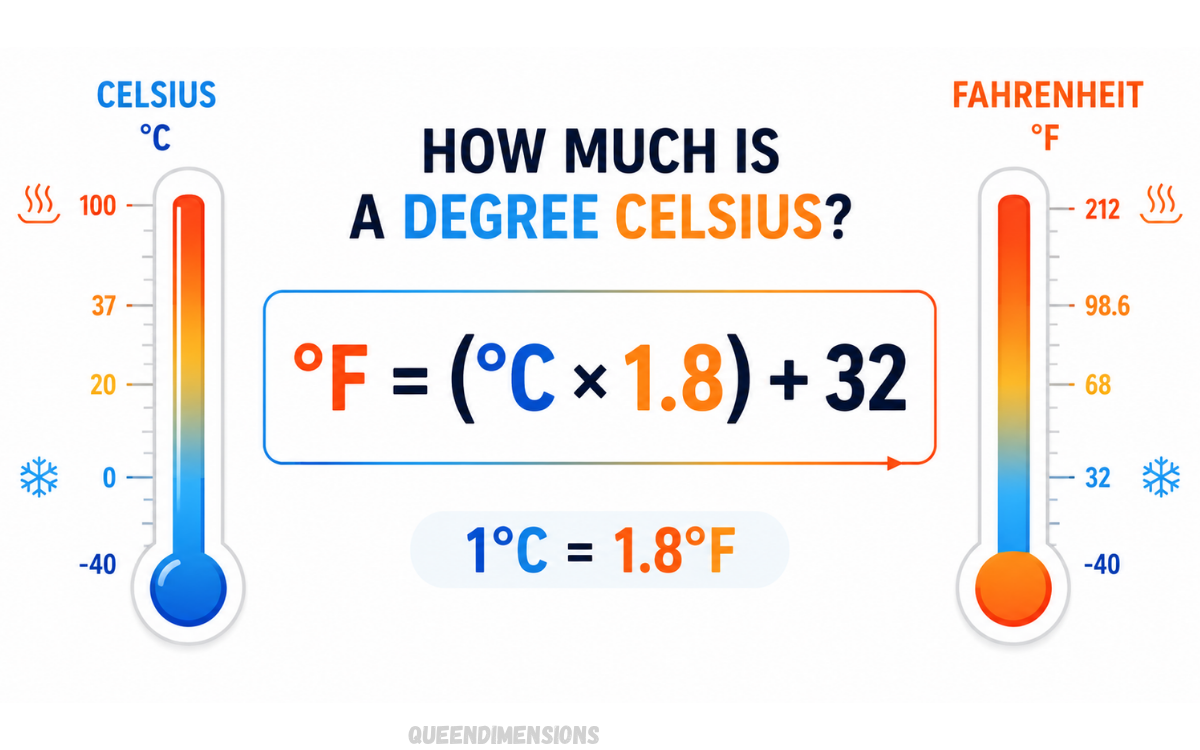
One degree Celsius equals 1.8 degrees Fahrenheit, and the exact conversion formula is °F = (°C × 1.8) + 32.
The Celsius scale uses 0°C as the freezing point of water and 100°C as the boiling point, making it the standard temperature system used in most countries worldwide.
If you live in the United States, you grew up with Fahrenheit. But the rest of the world runs on Celsius — including every science class, every international recipe, and every weather app set to global defaults.
This guide breaks it all down, from the basic formula to the real-life numbers that actually matter.
What Exactly Is a Degree Celsius ?
One degree Celsius is a unit of temperature measurement defined by the International System of Units (SI). It is the standard scale used by scientists, doctors, and everyday people in nearly every country on Earth.
The Celsius scale was developed by Swedish astronomer Anders Celsius in 1742. It was built around two fixed points of water: 0°C as the freezing point and 100°C as the boiling point at sea level. That 100-degree span covers the entire liquid range of water — which is why scientists worldwide use it as their standard.
Fahrenheit, by contrast, was created by Daniel Gabriel Fahrenheit in 1724. His 0°F was based on a salt-water-ice brine solution, and his upper point was human body temperature. The scale was practical at the time — but it was never designed with scientific simplicity in mind.
How to Convert Celsius to Fahrenheit ?
The Exact Formula
°F = (°C × 9/5) + 32
You can also write it as:
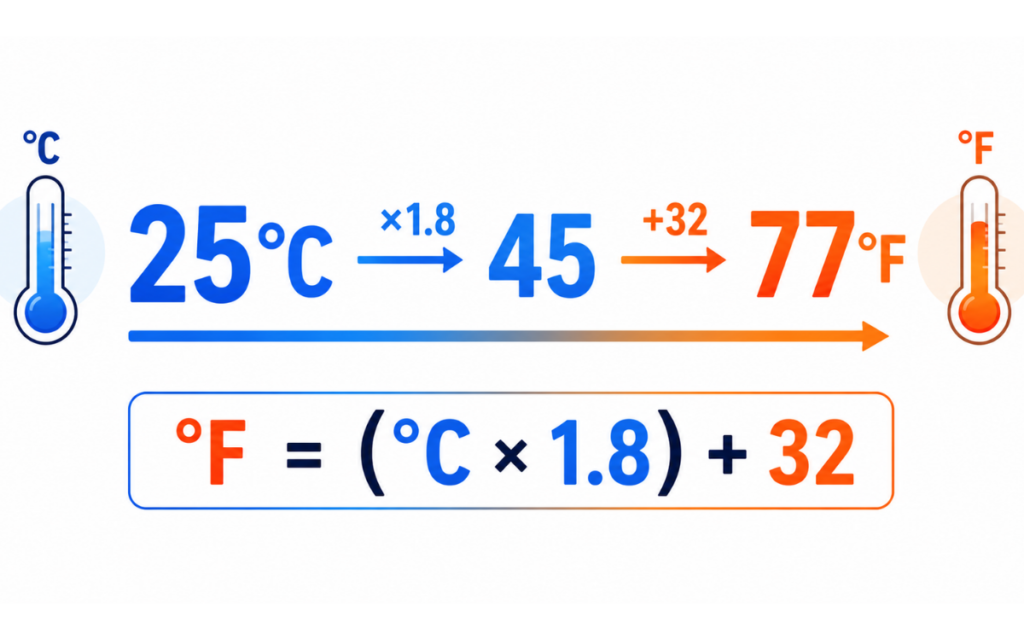
°F = (°C × 1.8) + 32
Both forms produce the same result. The 9/5 ratio (or 1.8) is the core conversion factor between the two scales. Add 32 to account for the offset between where the two scales start.
Step-by-Step Worked Example
Convert 25°C (a warm spring day) to Fahrenheit:
- Multiply: 25 × 1.8 = 45
- Add 32: 45 + 32 = 77°F
That’s it. 25°C = 77°F.
The 5-Second Mental Shortcut
No calculator? Use this quick estimate:
Double the Celsius value → then add 30
Example: 20°C → (20 × 2) + 30 = 70°F (actual answer: 68°F — within 2 degrees)
This shortcut works well for everyday weather temperatures between 0°C and 40°C. It won’t work for cooking or medical precision, but for checking whether to grab a jacket, it’s perfect.
More Posts:How Many Cups in a Pint? (With Real-Life Examples & Conversions) 2026
Essential Temperature Reference — The Numbers That Matter
| Situation | Celsius (°C) | Fahrenheit (°F) |
|---|---|---|
| Water freezes | 0°C | 32°F |
| Cool autumn day | 10°C | 50°F |
| Comfortable room | 20°C | 68°F |
| Warm summer day | 30°C | 86°F |
| Normal body temperature | 37°C | 98.6°F |
| Fever threshold | 38°C | 100.4°F |
| Water boils (sea level) | 100°C | 212°F |
| Both scales are equal | −40°C | −40°F |
Memorize just five of these — 0, 20, 30, 37, and 100 — and you’ll never feel lost reading a Celsius temperature again.
The Reverse: Fahrenheit to Celsius
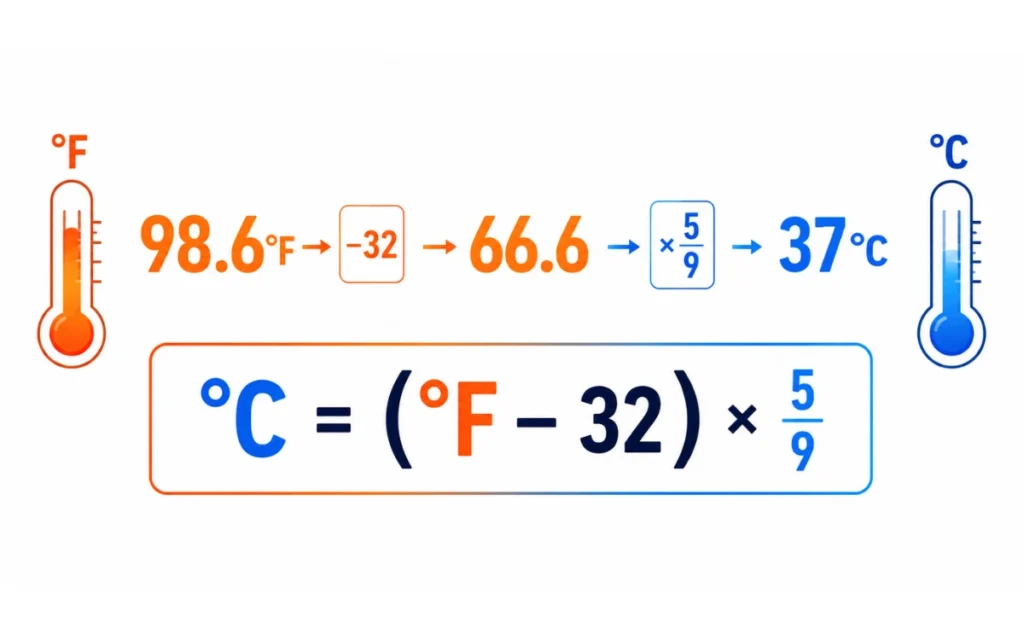
°C = (°F − 32) × 5/9
Example: Convert 98.6°F (body temperature) to Celsius:
- Subtract 32: 98.6 − 32 = 66.6
- Multiply by 5/9: 66.6 × 0.556 = 37°C
Quick reverse shortcut: Subtract 30 from the Fahrenheit value, then divide by 2. Example: 80°F → (80 − 30) / 2 = 25°C (actual: 26.7°C — close enough for everyday use)
One Celsius Degree Is NOT Equal to One Fahrenheit Degree
One degree Celsius does not equal one degree Fahrenheit.
One step up the Celsius scale equals 1.8 steps up the Fahrenheit scale. This is because the two scales have different-sized degrees. The Celsius degree is larger — it takes fewer of them to span the same temperature range.
The Scale Intersection: −40 Degrees
There is exactly one point where Celsius and Fahrenheit agree: −40 degrees. At −40°C = −40°F, both thermometers show the same number. You can verify it with the formula:
(−40 × 1.8) + 32 = −72 + 32 = −40°F ✓
This extreme cold is documented in regions like northern Canada and Siberia — and it’s dangerously life-threatening in either scale.
Frequently Asked Questions
How to convert Celsius to Fahrenheit?
Use the formula: °F = (°C × 1.8) + 32. Multiply the Celsius value by 1.8, then add 32. For a quick estimate, double the Celsius number and add 30.
What is 0 Celsius in Fahrenheit?
0°C = 32°F. This is the freezing point of water at standard atmospheric pressure. At this temperature, liquid water turns to ice. In American terms, it’s the temperature where roads ice over and pipes risk freezing.
What is 100 Celsius in Fahrenheit?
100°C = 212°F. This is the boiling point of water at sea level. Water reaches this temperature on your stovetop when making pasta or tea. At higher altitudes — like Denver, Colorado — water boils at a slightly lower temperature due to reduced atmospheric pressure.
How much is a degree Celsius?
One degree Celsius equals 1.8 degrees Fahrenheit. The Celsius degree is larger in size than the Fahrenheit degree. A 1°C temperature change feels nearly twice as large when expressed in Fahrenheit.
Conclusion
One degree Celsius = 1.8 degrees Fahrenheit. That ratio is the key to unlocking every Celsius-to-Fahrenheit conversion you’ll ever need.
Remember the formula — °F = (°C × 1.8) + 32 — and the five anchor temperatures: 0°C, 20°C, 30°C, 37°C, and 100°C. Pair that with the quick mental shortcut — double and add 30 — and you’ll never be lost reading a Celsius temperature again.
Whether you’re checking a European weather forecast, following a British recipe, monitoring a child’s fever, or just curious why the rest of the world reads temperature differently — you now have everything you need.

I’m the admin of CanSizeDimensions.com, sharing clear and accurate Measurement Guides to make everyday decisions easier. I enjoy simplifying complex dimension details so Readers Can Quickly understand sizes, comparisons, and practical uses. My goal is to provide helpful, reliable information for everyone.